An octagonal ring box where every surface is G4
A walnut ring box carved from one block, lined in upholstered velvet, with a spring-and-cam hinge that snaps open and shut, holding a 22kt gold signet with a boat in relief. Every designed surface is G4-continuous, the hinge's snap is the spring and cam's own torque, and the ring slot was sized with finite-element analysis. Everything you see is the CAD model, rendered live.
Drag to orbit, scroll or pinch to zoom. The gold reflects a cube map rendered at the ring from this scene: the velvet, the walnut and the open lid.
The snap hinge
The lid swings on a three-knuckle brass barrel. Inside it, a steel ball in a sliding follower is pushed by a coil spring onto a cam cut into the lid's knuckle; a flat on the pin keys the follower so the ball cannot turn with the lid.
Below the cam's ridge the spring and the lid's weight hold it shut. Push it past the ridge and the spring throws it open into the cam's open detent, with a brass stop lug on the lid knuckle landing on the base leaf as a hard stop behind it. The animation integrates that torque against the lid's own inertia, measured from the model.
The velvet ring slot
The ring stands in a slit between two velvet-covered foam cushions pressed together by the box wall. The shank spreads the slit, and the foam's push on its sides is what holds it. The question is which foam grips hard enough to keep the ring in when the box is shaken, but lets you push it in and lift it out with a fingertip.
Surface continuity: G4
Every designed surface — the walnut inside and out, the velvet, the ring and the hinge hardware — is G4-continuous. Surfaces meet (G0) without a crease (G1), and their curvature (G2), its rate of change (G3) and that rate's own change (G4) carry straight through every blend. Light slides over a G4 join with no line, which is what Zebra above shows: reflected stripes stay smooth across every blend. (Zebra shades the display mesh, so faint stair-steps on the softest velvet are triangle facets, not the surface.)
How it is built
Corners. Every rounded corner is a degree-8 Bézier with five control points on each straight leg. That forces the curvature, and its first and second derivatives along the curve, to zero at both ends, exactly matching the flats either side. An ordinary fillet is a circular arc: it meets the flat at G1 and jumps in curvature, which shows as a highlight line.
Free-form outlines (the boat relief, the hoop, the cam) are uniform quintic B-splines, C4 by construction.
Solids are an outline swept along a profile, so every surface inherits the G4 of the curves it was built from. Each closed surface is split into two half-faces along a straight run, and its flat caps meet it tangentially.
How it is checked
Kernel knot analysis. The CAD kernel grades every knot line of every surface from exact one-sided derivatives. For the check, each body is rebuilt as one unsplit surface with straight lead-ins at its caps, so its seams and cap joins are graded as interior lines too, not left as unchecked edges.
Control-row certificate. At every full-multiplicity knot, the four control rows on each side must lie on one line through the knot row: the exact condition for curvature and its first two derivatives to vanish on both sides. The kernel's own G3/G4 test compares fourth derivatives to about a billionth of the part's size cubed, finer than double precision can resolve at a knot tens of millimetres from the origin, so it reports most of these bodies as G2/G3 even where the control rows prove G4. Its grade is listed beside the certificate, not hidden.
Fold guard. Every inset outline (cushion crowns, the signet's frame and field, the relief) is checked not to turn back on itself. A fold is a self-intersection, not a continuity break, so the continuity tests alone would not catch it.
Exceptions, stated
The spring's cut wire ends are deliberate sharp (G0) edges, as on a real spring.
Where two separate solids touch — the signet head on its shank, the relief on the field, a leaf on its knuckle — that is a soldered or cast join between parts, not a blend inside one surface, and it is not graded.
The engraving (bright-cuts, pyramids, stipple, dots) is drawn by the renderer along the model's own coordinates, not cut into the solids.
Every body
The ring
A 22kt gold signet, modelled from photographs of the owner's ring: a rectangular head with a polished, stepped frame cut with diamond notches, a stippled field ringed with punched dots, and a boat in low relief — a ribbed, coiled prow, a grooved cabin with two rows of dots, a hull of three bright-cut scallops and a sun with a single slash. Thick, flat-sided shoulders carry a diamond-pyramid knurl. The head is hollowed behind its face, as a cast signet is.
How it is rendered
Every part is the CAD model's own boundary representation, tessellated by the kernel. The walnut is a three-dimensional procedural log — growth rings, fiddleback figure, pores and rays — that both halves are cut from, so the lid's grain continues the base's across the seam. The velvet is a sheen material over a soft pile. Gold and gems take their reflections from a cube map rendered at the ring each time the lid moves, so they reflect this box rather than a stock photograph.
More demos
All demos →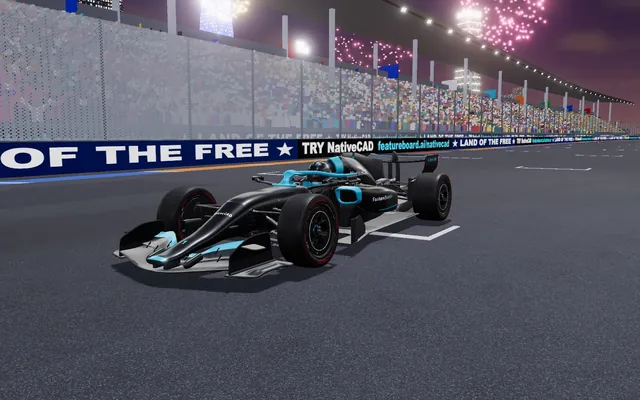
Track Limits: race a car designed in NativeCAD
A race game in your browser with cars designed in NativeCAD, AI opponents and a garage to look round them.
3 circuits, 2 cars Rear differential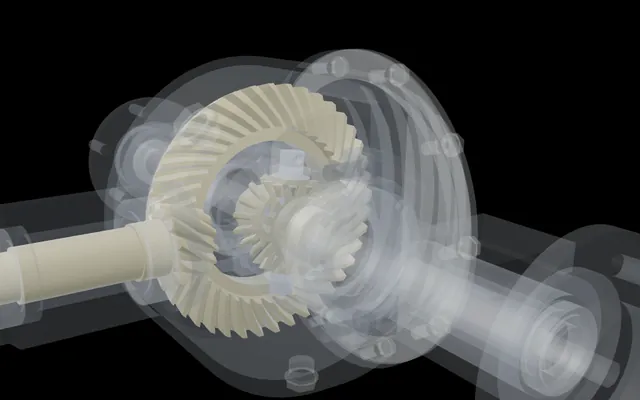
One wheel held, the other turns twice as fast
A complete rear differential with every bolt modelled, driven only by its mates, its feature tree open.
59 parts · 123 mates Space Program
Fly what NativeCAD builds, from an A-10 to a Saturn V
NativeCAD-built aircraft and spacecraft on a real-scale world, from a gun run to a Moon landing.
20 vehicles you can fly GE bracket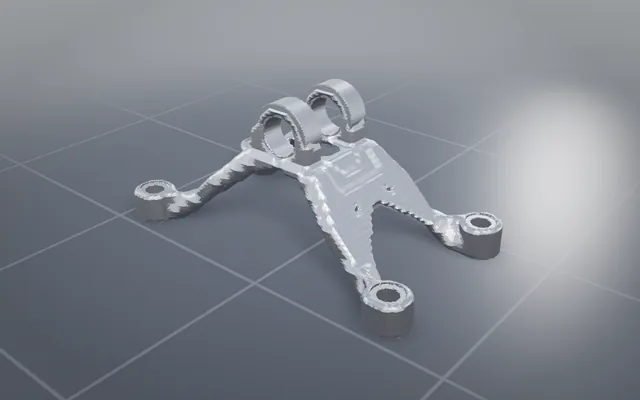
The GE jet engine bracket, lighter and carrying every load
The classic titanium bracket optimised and offered to print, cast, machine or weld, with STEP to download.
83.6% lighterBuild your own part with NativeCAD
Free for education and makers with a registered key · $200 per seat per year · Kernel SDK for products.