A metal AM part is expensive twice: once in engineering hours to design geometry only a printer can make, and again when the build fails. NativeCAD is CAD, FEA and CFD software driven by your AI assistant. It generates lattices and optimised shapes, checks them with solvers, keeps machined interfaces as exact faces, and prepares orientation and supports for the machine you run.
What AM teams do with NativeCAD
- Lighten parts with topology optimisation and get buildable geometry back.
- Fill volumes with graded lattices and gyroids that follow the part's shape.
- Keep bolted and sealing faces exact in the STEP file while the rest is implicit.
- Score build orientations and place supports away from functional surfaces.
- Hand off to your printer as STEP, 3MF with beam lattices, or a build package.
A turbine vane, ready for the printer in 116 seconds
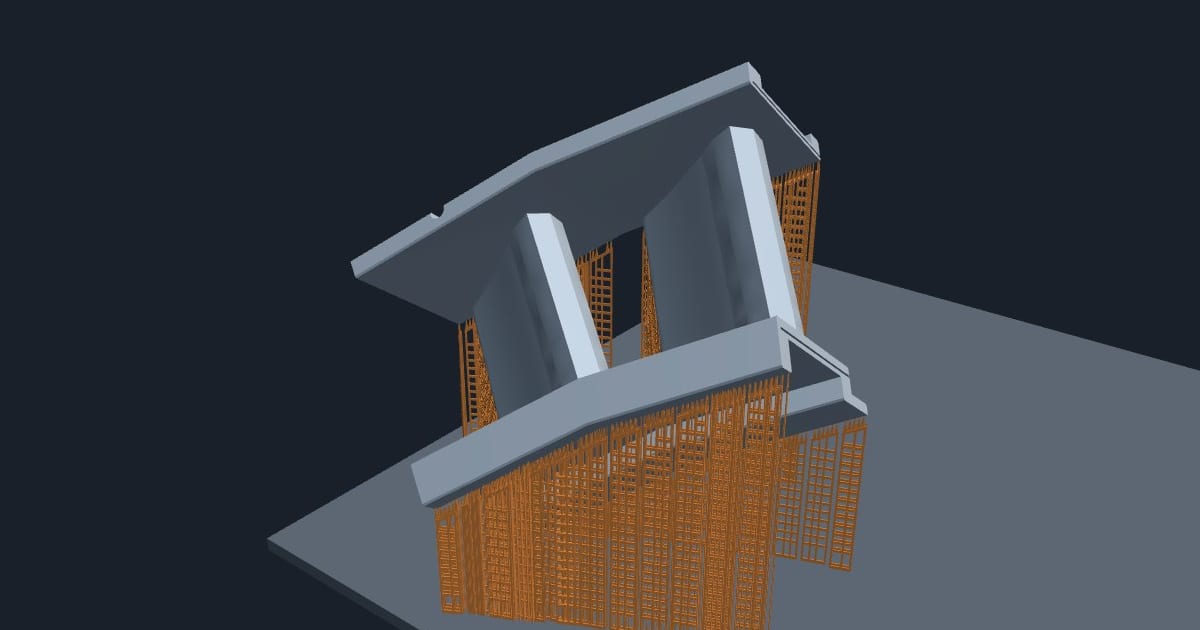
Metal AM build prep takes a turbine vane from its CAD file to a finished plate in 116 s. It scores 288 ways to stand the part up, places 11 supports with none on the surfaces the hot gas flows over, and holds up 94.8 % of overhangs as measured by a separate checker. The vane takes 3,444 layers.
170 metal printers, 12 technologies
The printer catalogue lists 170 metal 3D printers from 60 makers across 12 technologies, 113 of them with a handoff package. Build volume, process limits and file handoff are data the assistant reads when it checks whether your part fits your machine.
Optimised brackets and exact interfaces
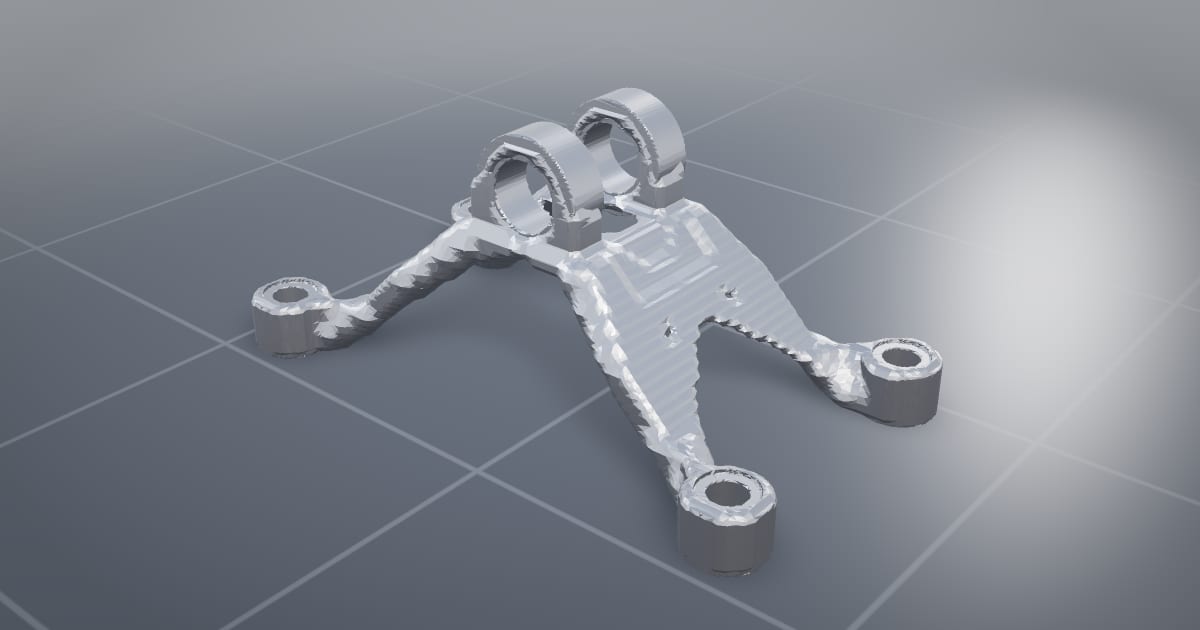
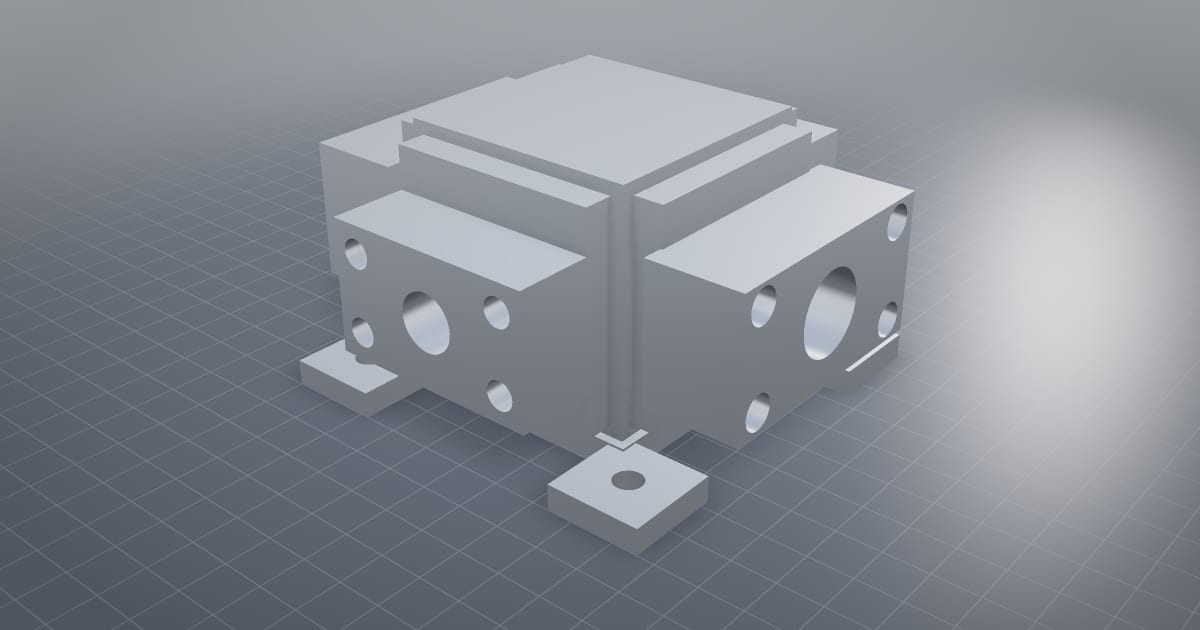
The GE jet engine bracket drops from 2.04 kg of Ti-6Al-4V to 336 g with 1.76× the stiffness per kilogram, in 5 of 5 buildable versions that carry all four challenge loads. Implicit where it breathes, exact where it bolts shows the file strategy: a lattice bracket 34% lighter than solid at a 2.4x worst-case safety factor, with 13 of 13 interface faces kept exact in the STEP and a file 8.7x smaller than implicit-only. The titanium clevis bracket ships as STEP, beam-lattice 3MF and a drawing with true position.
Heat exchangers that meet their duty
The gyroid heat exchanger removes 515 W against 482 W required, a 6.9 % margin, with 0 leak paths between the air and coolant networks and 2.7 kPa air-side pressure drop, in 696 g of AlSi10Mg. The hydrogen fuel-cell precooler prints as one piece with 267 tubes and removes 10.3 kW.
Lattices that follow the skin
On the curved skin panel, 0 of 390 lattice cells are clipped by the skins, where a straight-grid core has all 954 of its cells cut. Peak strut stress is 4.4× lower (13.4 against 58.8 MPa) and the first natural frequency is 43 % above the same-mass solid panel.
What to ask your assistant
Optimise this bracket for these four load cases and keep the bolt bosses solid.
    Fill the core with a gyroid, 1 mm wall, and check the two fluid networks never connect.
    Find the best build orientation with no supports on the sealing face.
    Does this fit my printer's build volume? Export 3MF.
For printed ceramic casting moulds see NativeCAD for foundries, and for polymer and desktop printing see NativeCAD for 3D printing services.
Questions metal AM engineers ask
Can NativeCAD design lattice structures for metal 3D printing?
Yes. NativeCAD fills volumes with graded and conformal lattices and gyroids, runs FEA on the result, and exports STEP with exact interface faces or 3MF with beam lattices.
Which metal 3D printers does NativeCAD support?
The printer catalogue covers 170 metal 3D printers from 60 makers across 12 technologies, with a handoff package for 113 of them.
What does NativeCAD cost?
A NativeCAD MCP / Modeler seat is $200 per seat per year, or $20 per seat per month, with no metered usage. The evaluation needs no key and no sign-up; export, save and import need a seat key. See pricing.
Does my geometry leave my computer?
NativeCAD runs on your own machine: the kernel and solvers run locally and licence validation is fully offline. Files opened in the browser modeler are never uploaded. Your AI assistant sees what you ask it to work on, under your agreement with its provider.
NativeCAD in other industries
- NativeCAD for Drone Manufacturers: Airframe, Airflow and Every Revision Checked
- NativeCAD for Automotive: Drivelines, Tolerance Stacks and Thermal Parts Your AI Can Check
- NativeCAD for Motorsport: More Design Iterations Between Races
- NativeCAD for Aerospace and Turbomachinery: Blades, Casings and Qualification Reports
- NativeCAD for Robotics and Weld Cell Integrators: Program the Cell From the CAD Model
- NativeCAD for CNC Job Shops: From the Customer's Drawing to a Checked Solid
- NativeCAD for Sheet Metal Fabricators: Flat Patterns, Bend Checks and Drawings by Conversation
- NativeCAD for 3D Printing Services and Product Designers: Fuller Builds, Parts That Work Off the Bed
- NativeCAD for Foundries and Casting: Part In, Mould Out
- NativeCAD for Electronics Hardware Teams: Check the Board and Fit the Enclosure Before You Build
- NativeCAD for Furniture Makers and Woodworkers: A Desk Designed in Ten Messages
- NativeCAD for Game Studios and 3D Asset Teams: Engineering-Grade Models as Runtime Assets
- NativeCAD for Simulation Teams: FEA and CFD Set Up and Run by the Agent That Built the Part
- NativeCAD for Defense and Regulated Manufacturing: AI-Built Parts Inside Your Own Boundary
NativeCAD is CAD, FEA and CFD software your AI assistant drives over MCP, from Claude, Cursor or your own agent, and in the browser. Every part is an exact B-rep solid that exports as STEP AP242. See what it does, browse every demo, check pricing, or install it.