The GE jet engine bracket, 84.3% lighter
The bracket 629 engineers raced to lighten in the 2013 GE challenge — 2.04 kg of titanium — optimised by NativeCAD for all four challenge loads at once and handed back as parts you can build: printed, cast, machined from plate or welded from flat stock, each checked in CalculiX.
Load paths
Switch the viewer to Load paths to see the bracket reduced to its skeleton: 17 members and 14 joints, each drawn at the thickness the optimiser gave it and coloured by the stress it carries across all four cases. The hardest-working members are the two arches under the clevis lugs, at 55% of yield under the 42° load. Versions D, E and F are laid out on that skeleton, and every version has its own: pick one with the chips to see where its load actually goes.
Every version, one scoreboard
| Version | Mass | Vertical stiffness | Safety factor, worst case | Build |
|---|---|---|---|---|
The 2013 design envelope, rebuilt in NativeCAD |
2.04 kg | 400 kN/mm | 1.55 CalculiX, 175k-node tet mesh |
Machined billet |
Topology optimisation, 20 % of the envelope |
419 g 79.5% lighter |
224 kN/mm 1.76× stiffness per kg |
1.28 NativeCAD FEA, 1 mm grid |
Reference shape |
A with exact bores, seats and lug eyes |
419 g 79.5% lighter |
235 kN/mm 1.76× stiffness per kg |
1.29 CalculiX, 148k-node tet mesh |
Metal AM (DMLS) 24,000-face B-rep |
Optimised at 15 %, same interfaces |
321 g 84.3% lighter |
184 kN/mm 1.59× stiffness per kg |
1.36 CalculiX, 154k-node tet mesh |
Metal AM (DMLS) 24,000-face B-rep |
Four straight legs on the load paths, editable feature tree |
391 g 80.9% lighter |
225 kN/mm 1.05× stiffness per kg |
1.60 CalculiX, 150k-node tet mesh |
Investment casting or metal AM 24,000-face B-rep 14 features |
Plates and ribs on the load paths, nothing overhangs from the top |
763 g 62.7% lighter |
122 kN/mm 0.8× stiffness per kg |
1.76 CalculiX, 149k-node tet mesh |
3-axis CNC from plate, 2 setups 24,000-face B-rep 18 features |
Seven flat plates on the load paths |
790 g 61.3% lighter |
129 kN/mm 0.83× stiffness per kg |
2.10 CalculiX, 149k-node tet mesh |
Waterjet-cut plate, TIG welded 24,000-face B-rep 18 features |
| Published winner, 2013 challenge | 327 g | Published result, Designs 5(4):77 |
Safety factor against the Ti-6Al-4V yield of 903 MPa (131 ksi, the challenge figure), worst of the four load cases. The four bolt bores are held rigid, as the challenge specifies; the idealised rigid edge where a bore meets the underside is singular, so the CalculiX peak is taken 3 mm clear of the bolt bores. Stiffness is the pin load over the pin's travel under the 35.6 kN vertical case.
One bracket, every way to make it
The four challenge loads
Bolts rigid, pin rigid, Ti-6Al-4V — the challenge's own rules. All four cases are optimised together, not one at a time.
Run it on your part
The same optimisation is one call in the NativeCAD MCP server — cad_topopt: pick the faces that must stay, the faces that are bolted, the faces that are loaded, and a weight budget. It returns the optimised shape and its numbers, ready for cad_mesh_to_brep and a CalculiX check with cad_fea_case.
More demos
All demos →
A planetary gearbox you can wear, printed in one piece
A working gearbox pendant that comes off a desktop printer already assembled and turning, in two colours.
5 moving parts, one print Implicit vs explicit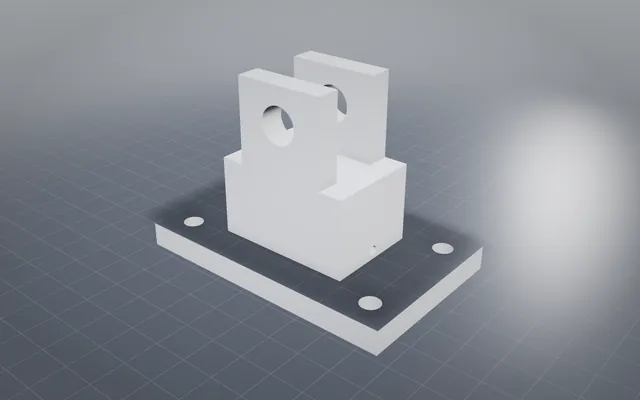
Implicit where it breathes, exact where it bolts
Lattices and graded cores on the same body as true bolt holes, with STEP, drawings, analysis and print prep.
Heat exchanger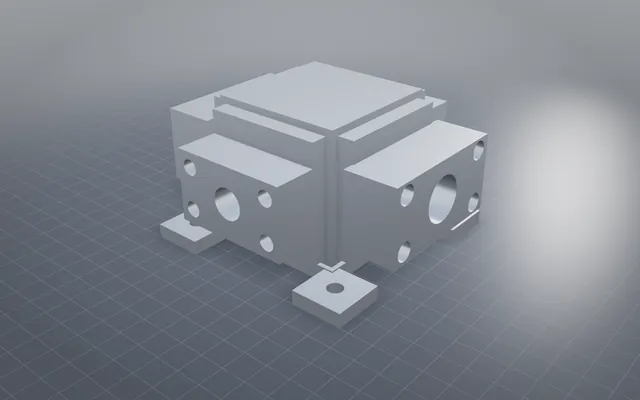
A printed gyroid heat exchanger that meets its duty
A two-fluid gyroid core with no leak path between the fluids, exact flanges and a toleranced drawing.
515 W vs 482 W required FEA loop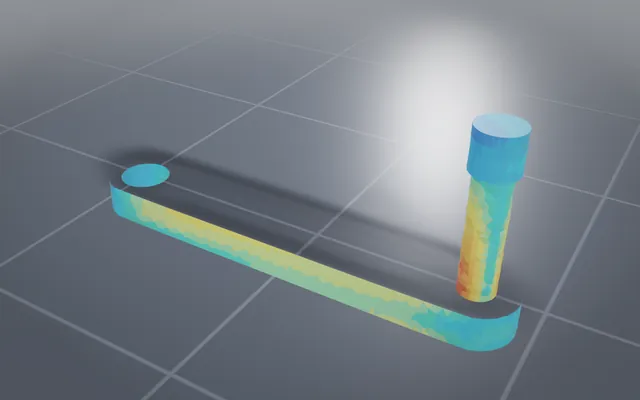
Finite-element analysis your agent can run
Stress and vibration results from the same AI session that built the part, with the peak and its margin.
6 designs solved in FEABuild your own part with NativeCAD
Free for education and makers with a registered key · $200 per seat per year · Kernel SDK for products.