A curved skin panel whose lattice follows the skin
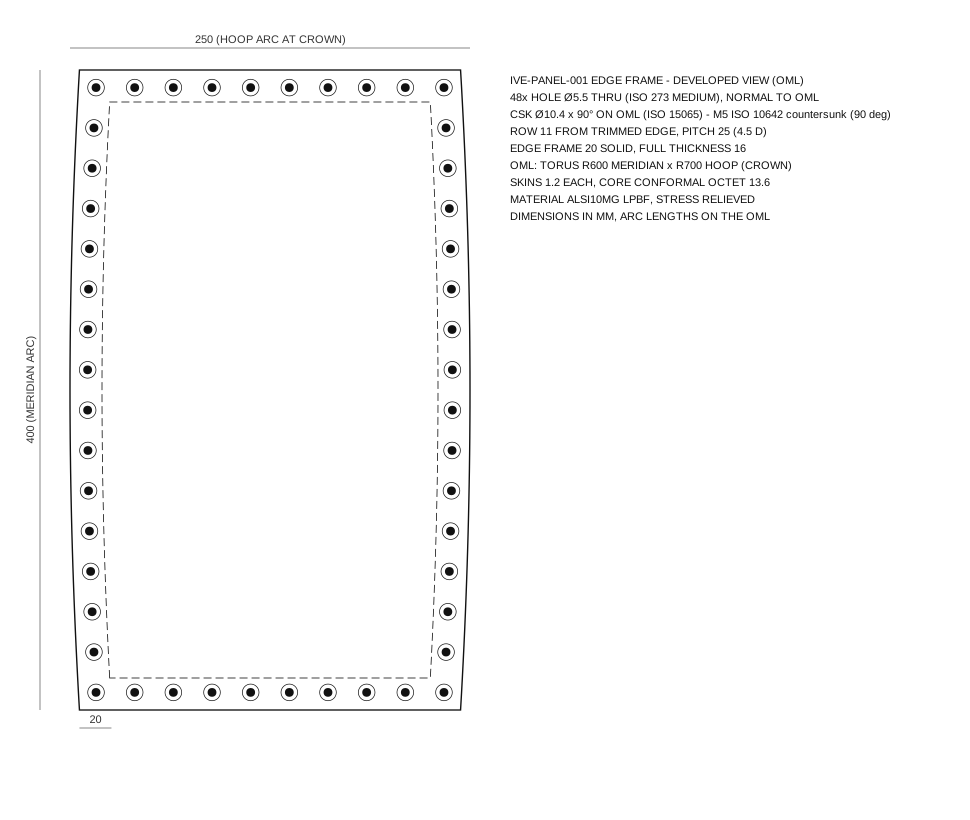
A 400 × 250 mm doubly curved nacelle skin panel. The skins are exact toroidal faces, the edge frame is solid with 48 M5 countersunk fastener holes on a real 25 mm pitch, and the octet core bends with the skin, so every one of its 390 cells is whole. We built the same panel twice more at exactly the same 672 g: once with the same lattice on a straight grid, once as a thinned solid sheet.
Drag to orbit, pinch or scroll to zoom. The close-up frames one node on the outer skin: on the conformal core the struts land on the skin at whole nodes; switch to the straight grid to see struts cut off mid-length where the skin passes through them. Show clipped struts colours every strut the skin cuts through in orange. The conformal core has none; switch to the straight-grid core to see them, mostly where the curved skin crosses the flat grid.
Same mass, three panels
All three carry 672 g of AlSi10Mg inside the 20 mm edge frame, see 35 kPa on the outer skin and are held by the fastened frame. The lattice cores use the same octet cell (13.6 mm, the core depth); equal mass sets each strut diameter. The conformal core is a single layer of 15 × 26 = 390 cells bent to follow the skin. A flat grid has to stack extra layers to reach every part of a curved core, and the skins pass through all of them, so the straight-grid core has 954 partial cells and 0 whole ones.
| Conformal | Straight grid | Solid | |
|---|---|---|---|
| Mass | 672 g | 672 g | 672 g |
| Clipped cells | 0 of 390 | 954 of 954 | – |
| Clipped struts | 0 of 11,084 | 7,236 of 12,918 | – |
| Strut Ø / sheet | Ø0.97 mm | Ø1.06 mm | 3.42 mm |
| Peak strut stress | 13.4 MPa | 58.8 MPa | – |
| 99th pct strut stress | 11.7 MPa | 23.7 MPa | – |
| Peak skin stress | 4.5 MPa | 4.5 MPa | 8.3 MPa |
| Max deflection | 23.5 µm | 22.8 µm | 31.4 µm |
| Mean deflection | 9.8 µm | 9.9 µm | 13.8 µm |
| Pressure stiffness | 265 kN/mm | 261 kN/mm | 187 kN/mm |
| First mode | 2,443 Hz | 2,416 Hz | 1,711 Hz |
Pressure stiffness is the total pressure force on the core area (2,587 N) divided by the mean outer-skin deflection. Max deflection is the single worst point on the skin.
The skins carry most of a curved panel's pressure load, so the two lattice cores end up close in stiffness. The difference is in the struts. Where the straight grid meets a curved skin it leaves stubs and part-cells, and the load concentrates in them. The single most-loaded strut works 4.4 times harder than anywhere in the conformal core, and across the worst 1 % of struts the straight grid still works 2.0 times harder. Stubs no longer than their own diameter are counted as part of the skin, not as beams, so the peak is not a degenerate stub.
Every one of these stresses sits well below the alloy's yield strength: the worst, in the straight grid, is about 26 % of a typical 230 MPa, and the conformal core's peak is about 6 %. Neither panel is close to breaking. The gain is margin: fatigue life on an engine panel, or a thinner core for the same margin.
The edge frame
The fastened frame is the part a lattice must never touch: exact faces, holes on a true pitch, countersinks normal to the skin. 48 holes Ø5.5 for M5 ISO 10642 countersunk screws, 90° countersink Ø10.4 on the outer mould line, 11 mm (2 D) in from the trimmed edge. Drilling the full row moves the first mode and the core's peak strut stress by under 1 %.
Downloads
More demos
All demos →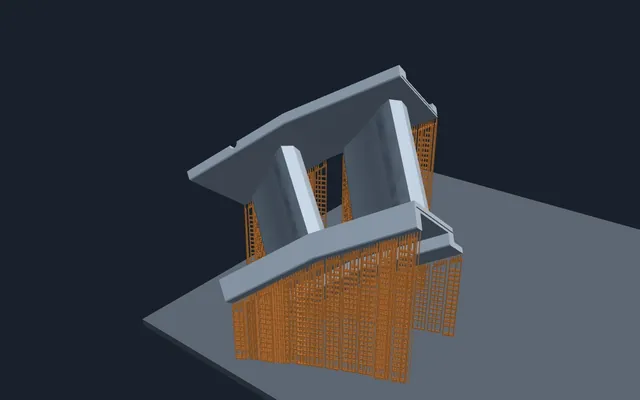
A turbine vane ready for the metal printer in under two minutes
Orientation, supports and a full build plate chosen automatically, then graded by an independent checker.
94.8% of overhangs held up 3D nesting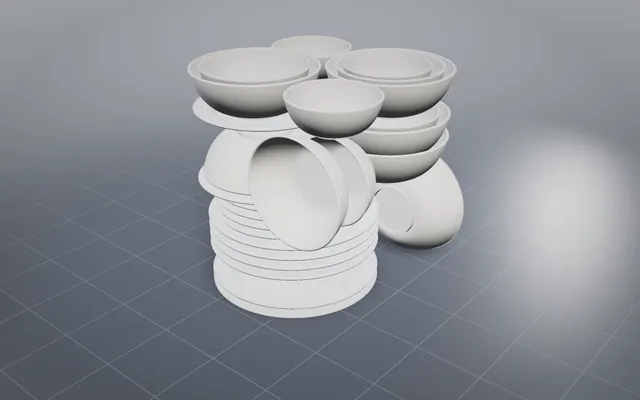
A whole dinner service nested in one SLS build
Bowls inside bowls and plates under plates, every gap proved on the real triangles before the build starts.
30 pieces, one SLS build GE bracket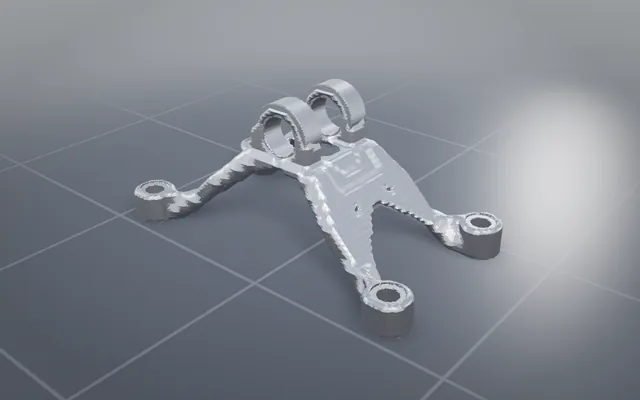
The GE jet engine bracket, lighter and carrying every load
The classic titanium bracket optimised and offered to print, cast, machine or weld, with STEP to download.
84.3% lighter FEA loop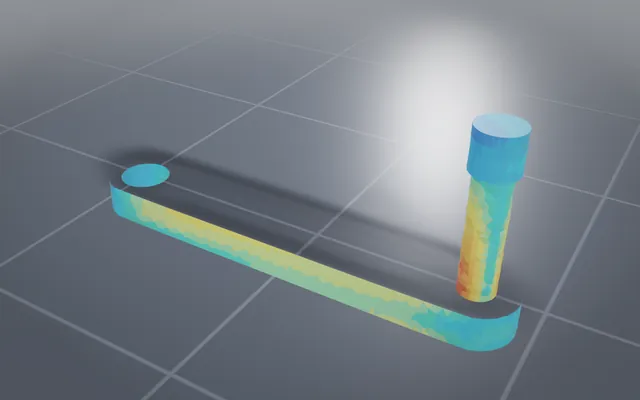
Finite-element analysis your agent can run
Stress and vibration results from the same AI session that built the part, with the peak and its margin.
6 designs solved in FEABuild your own part with NativeCAD
Free for education and makers with a registered key · $200 per seat per year · Kernel SDK for products.