Between two race weekends a team has a fixed number of hours and an open list of ideas. The limit is how many of those ideas reach a checked, makeable part. NativeCAD is CAD, FEA and CFD software driven by your AI assistant: it models exact surfaces and solids from a brief, runs structural and manufacturing checks, and exports STEP for the machine shop or the printer.
What race teams do with NativeCAD
- Run more design variants. The assistant builds and checks options while engineers are at the track.
- Take mass out with proof. Topology optimisation and lattice cores with FEA on the result.
- Check every bolted joint and stack. Preload per VDI 2230, thread engagement, clash at every position.
- Use one model for design and simulation. Mass, centre of gravity and pickup points measured off the CAD.
A whole race car from one exact model
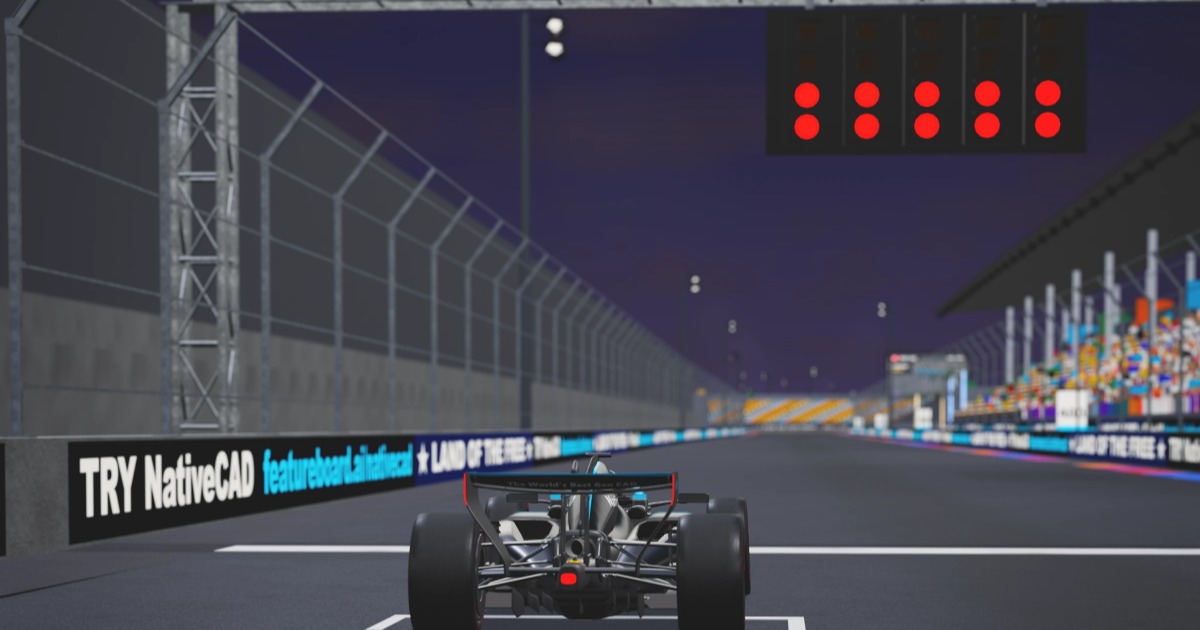
Track Limits is a browser racing game built on a NativeCAD car. Every panel you see is meshed from its exact B-spline surfaces, and the mass, centre of gravity and suspension points the game uses are measured off the same model. It has four circuits (Jeddah, Carole, Le Mans and the Nordschleife) and up to seven AI opponents. For a team the point is the data path: the geometry that goes to manufacture is the geometry the vehicle model reads, with no hand-copied spreadsheet in between.
Powertrain hardware at full part count
The V12 engine is a 6.0-litre 60° DOHC unit with crank, rods, pistons, four camshafts and 48 valves, running live at firing order 1-7-5-11-3-9-6-12-2-8-4-10. The rear differential is a 3.73:1 spiral bevel set with 59 parts and every bolt modelled. The transaxle checks found 0 clashes across 620 touching part pairs and worked out 43.42 N·m on each of the 16 case flange bolts per VDI 2230.

Lightweighting you can defend at scrutineering
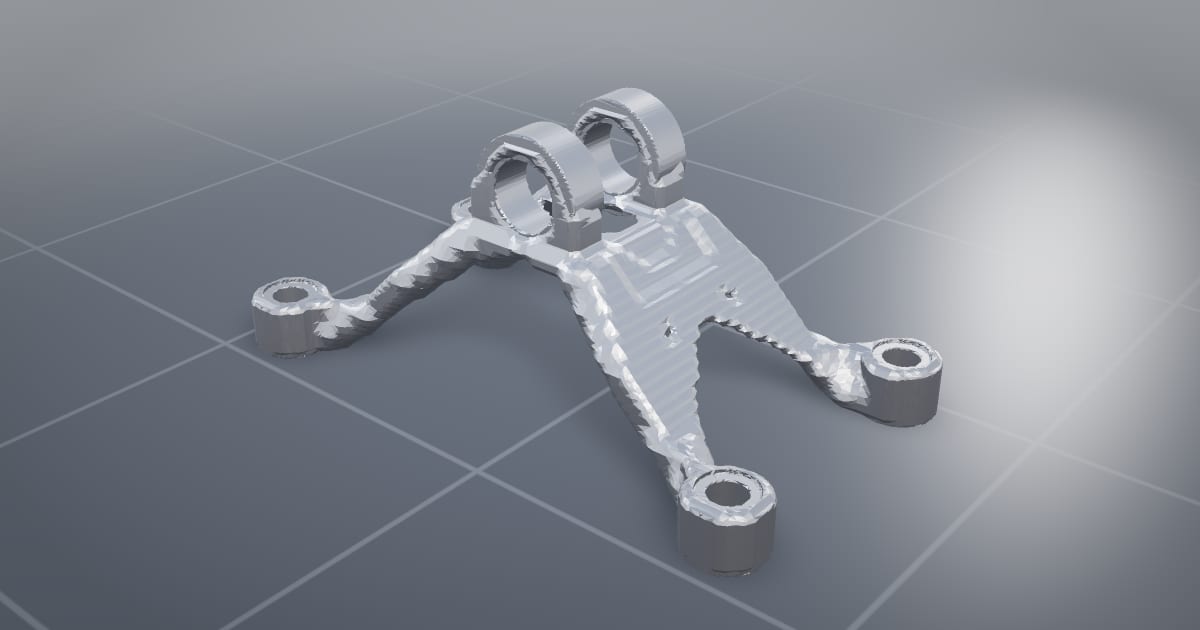
The GE jet engine bracket goes from 2.04 kg of Ti-6Al-4V to 336 g, 83.6% lighter, in versions you can print, cast, machine or weld. The curved skin panel uses a lattice that follows the skin: 0 of 390 cells clipped, 4.4× lower peak strut stress than a straight-grid core, and a first natural frequency 43 % above the same-mass solid panel. Those are the tools for an upright bracket, a wing mount or a floor stay.
Surfaces that hold up in reflection
Bodywork needs more than tangency. NativeCAD builds curvature-continuous surfaces and grades every join from G0 to G4. The ring box has 36 of 36 surfaces at G4, and the method is written up in G4 Surfaces, and Where NativeCAD Stands.
What to ask your assistant
Lighten this upright bracket by 30% and keep a safety factor of 1.5 on the braking case.
    Work out bolt preload for the bellhousing flange per VDI 2230.
    Give me the mass, centre of gravity and inertia of the full assembly.
    Export the wing mount as STEP and a drawing with true position on the bolt pattern.
The DFM knowledge packs include motorsport, race-engines and composites.
Questions motorsport engineers ask
Can NativeCAD do topology optimisation for race car parts?
Yes. The topology optimisation tool removes mass under your load cases and returns buildable geometry. The public demo lightens the GE jet engine bracket by 83.6% with all four load cases carried.
Does NativeCAD produce Class-A style surfaces?
NativeCAD builds G3 and G4 surfaces and grades every join from G0 to G4 against stated tolerances, so continuity is measured and reported with the part.
What does NativeCAD cost?
A NativeCAD MCP / Modeler seat is $200 per seat per year, or $20 per seat per month, with no metered usage. The evaluation needs no key and no sign-up; export, save and import need a seat key. See pricing.
Does my geometry leave my computer?
NativeCAD runs on your own machine: the kernel and solvers run locally and licence validation is fully offline. Files opened in the browser modeler are never uploaded. Your AI assistant sees what you ask it to work on, under your agreement with its provider.
NativeCAD in other industries
- NativeCAD for Drone Manufacturers: Airframe, Airflow and Every Revision Checked
- NativeCAD for Automotive: Drivelines, Tolerance Stacks and Thermal Parts Your AI Can Check
- NativeCAD for Aerospace and Turbomachinery: Blades, Casings and Qualification Reports
- NativeCAD for Robotics and Weld Cell Integrators: Program the Cell From the CAD Model
- NativeCAD for CNC Job Shops: From the Customer's Drawing to a Checked Solid
- NativeCAD for Sheet Metal Fabricators: Flat Patterns, Bend Checks and Drawings by Conversation
- NativeCAD for Metal Additive Manufacturing: Design for the Printer, Then Prove the Part
- NativeCAD for 3D Printing Services and Product Designers: Fuller Builds, Parts That Work Off the Bed
- NativeCAD for Foundries and Casting: Part In, Mould Out
- NativeCAD for Electronics Hardware Teams: Check the Board and Fit the Enclosure Before You Build
- NativeCAD for Furniture Makers and Woodworkers: A Desk Designed in Ten Messages
- NativeCAD for Game Studios and 3D Asset Teams: Engineering-Grade Models as Runtime Assets
- NativeCAD for Simulation Teams: FEA and CFD Set Up and Run by the Agent That Built the Part
- NativeCAD for Defense and Regulated Manufacturing: AI-Built Parts Inside Your Own Boundary
NativeCAD is CAD, FEA and CFD software your AI assistant drives over MCP, from Claude, Cursor or your own agent, and in the browser. Every part is an exact B-rep solid that exports as STEP AP242. See what it does, browse every demo, check pricing, or install it.