A dinner service for six, nested in one SLS build
30 pieces of tableware packed into one EOS P 396 build 352 mm tall: bowls inside bowls, plates stacked into each other's wells, and pieces tucked under other pieces' rims. That is 1.81× the density of packing the same pieces by their bounding boxes, which would need 639 mm of Z and would not fit the machine. Every pair of pieces is at least 3 mm apart, proved on the real triangles.
Drag to orbit, pinch or scroll to zoom. Slide the build order to watch the bed fill from the bottom; turn on the cutaway to see the bowls inside bowls and the pieces under the rims.
Nested against boxed
The same 30 pieces, the same packer, the same 3 mm gap and the same search. The only difference is whether a piece's hollow is usable space.
How the pieces fit together
- Bowls in bowls. The 18 bowls sit inside one another, smaller in larger, each one clear of the bowl around it by 3 mm of powder.
- Plates in plates. Dinner and side plates stack into each other's wells, upright and upside down, foot ring into well.
- Under the rims. Pieces tuck under the overhanging rims and flanges of the pieces above them. In a powder bed nothing needs a path in or out, only a gap.
- Proved twice. Every pair of pieces is checked on the real triangles by cad_nest's own proof and again by a second, separately written checker. Both report 0 collisions and a closest gap of 3.00 mm.
| Piece | In the build | Size | Wall |
|---|---|---|---|
| Dinner plate | 6 | 266 × 27 mm | 3.5 mm |
| Side plate | 6 | 210 × 21 mm | 3 mm |
| Soup bowl | 6 | 190 × 68 mm | 2.5 mm |
| Cereal bowl | 6 | 160 × 60 mm | 2.5 mm |
| Dessert bowl | 6 | 130 × 51 mm | 2.5 mm |
Each piece is a revolved solid from the NativeCAD kernel: well, rim and foot ring. The build is SLS, PA12 at 3 mm between parts and 5 mm off the chamber walls.
X1 Carbon plate: 15 Labs Planetary pendants
15 working Labs Planetary pendants, each a print-in-place gearbox with six planets, nested on one Bambu X1 Carbon plate at 54% utilisation. No two pendants come closer than 5.2 mm, proved on the real triangles. Every pendant prints back face down, the orientation the X1C rule pack ranks first, and the plate takes about 7 h 30 min at 0.12 mm layers in two colours. That figure is an estimate from the part volumes, not a slice.
Drag inside the scene to orbit, scroll to zoom. Each pendant is 52.8 × 68.1 × 14 mm with its bail; cad_nest turned them in 90° steps so each bail tucks in between its neighbours, 5 mm apart and clear of the purge corner.
More demos
All demos →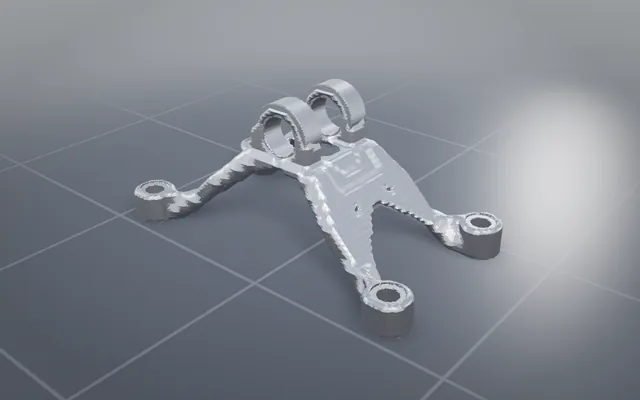
The GE jet engine bracket, lighter and carrying every load
The classic titanium bracket optimised and offered to print, cast, machine or weld, with STEP to download.
84.3% lighter Printed pendant
A planetary gearbox you can wear, printed in one piece
A working gearbox pendant that comes off a desktop printer already assembled and turning, in two colours.
5 moving parts, one print Implicit vs explicit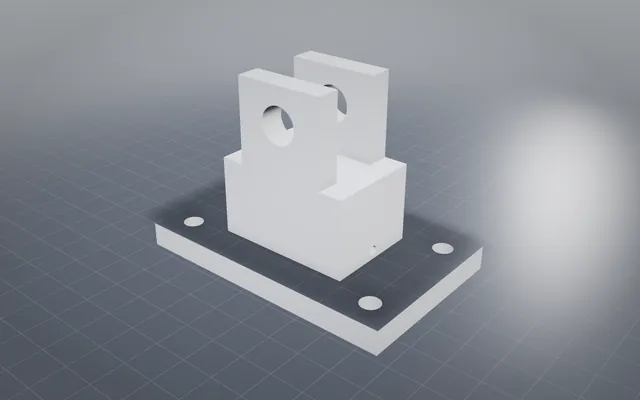
Implicit where it breathes, exact where it bolts
Lattices and graded cores on the same body as true bolt holes, with STEP, drawings, analysis and print prep.
FEA loop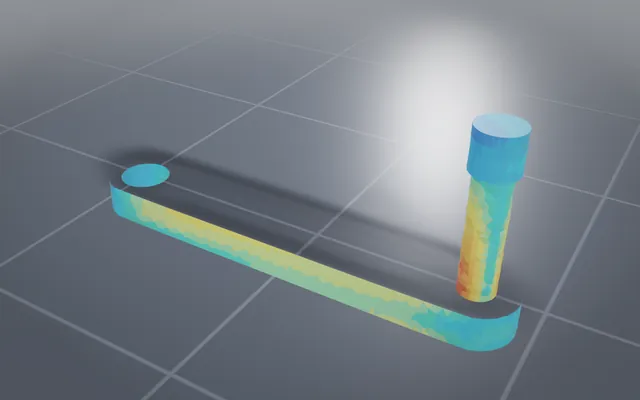
Finite-element analysis your agent can run
Stress and vibration results from the same AI session that built the part, with the peak and its margin.
6 designs solved in FEABuild your own part with NativeCAD
Free for education and makers with a registered key · $200 per seat per year · Kernel SDK for products.