The latest additions to Vanguard. Every name and number here is read from the game's own code when this page is written, and the page's test fails if the game changes without it.
Inside the Bison
Buttoned up, the camera now rolls with the hull, so the crew compartment stays put round you and the world tilts on a slope. The gunner's sight is a round eyepiece that fills most of the screen while he looks along the gun, its reticle and range marks on the gun's line, and his own barrel no longer cuts across the picture; look off the gun and he sits back from it into the turret. The compartment is painted, worn and lit like the troop bay: each station has its own crew lamps; round the gunner are his control handles, the traverse and elevation handwheels, hydraulic lines and cable looms, intercom boxes, a fire extinguisher, the commander's sight overhead and the ready rack open on its round bases, and the driver has a bezelled panel of gauges and guarded switches, shaped tillers and the edge of his glacis in the vision block. A hit inside throws sparks and spall off the nearest wall, shakes dust into the lamp light, rings the screen and makes the lamps stutter.
Crew the tank
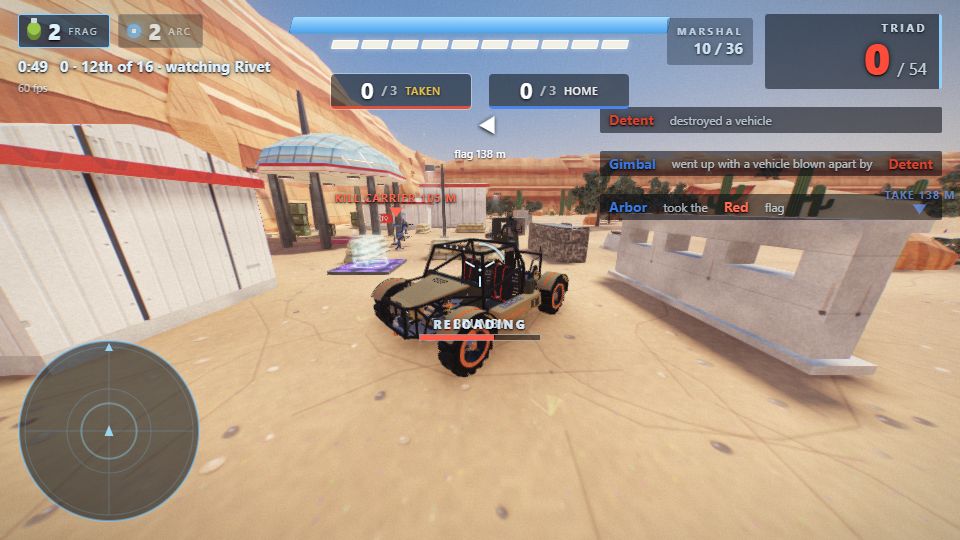
You can now choose where you come in: the troop bay of a Pangolin as before, the Bison's driver's seat or its gunner's, or a seat in a buggy. Choose on the loading screen beside the briefing and you roll the Bison out of your base at the head of the convoy, the opening cinematic following your tank; after a death a strip offers the same 4 choices again on the number keys, and a crew seat goes to a living tank of your side or, with none free, you come in on foot and are told why. Choose nothing and nothing changes. In either crew seat H buttons you up: the hatch shuts and you drop inside the hull, where nothing but the tank's own end can reach you. The driver looks out through his vision block and the gunner through his sight, 1.8 times closer, with a reticle carrying range marks and the range under the cross. Round you is the tank's interior, about 87,230 triangles of it, fetched only once you are crew: the driver's seat, tillers and amber-lit panel, the turret basket with the gunner's seat, the breech and its recoil guard, the ready rack and the loader's rounds, lit by red and amber crew lamps that stutter when the hull takes a hit.
The Brumby, restyled and lifted
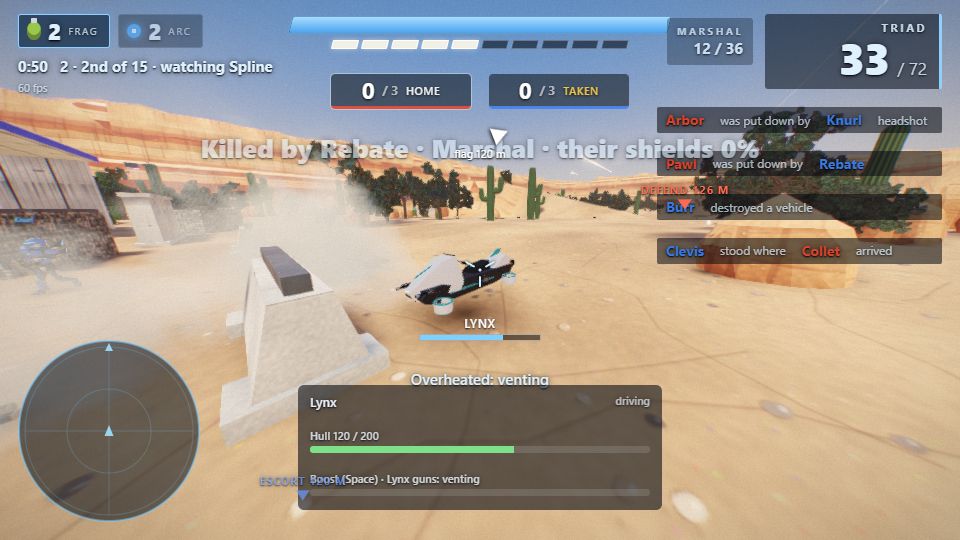
The Brumby has a new body: smooth sand armour broken by crisp creases and chamfers. A faceted cowl runs over the nose with a crest and louvres, a heavy bumper carries a fairlead and shackles, flared arches stand over each wheel, round over the tyre and faceted outside with a darker lip, and faceted sills and rear quarters close in the sides. It rides higher on bigger tyres, 127 cm across, with 79 cm of wheel travel: the arms reach down to the hubs and the long coil-overs show in the wheel wells. Its weight is kept low, so it leans in a turn no more than it did and stays on its wheels over the ramps and roads of Rimefall and Ochre. Every part is checked so none floats off the frame.
A troop bay that looks like one
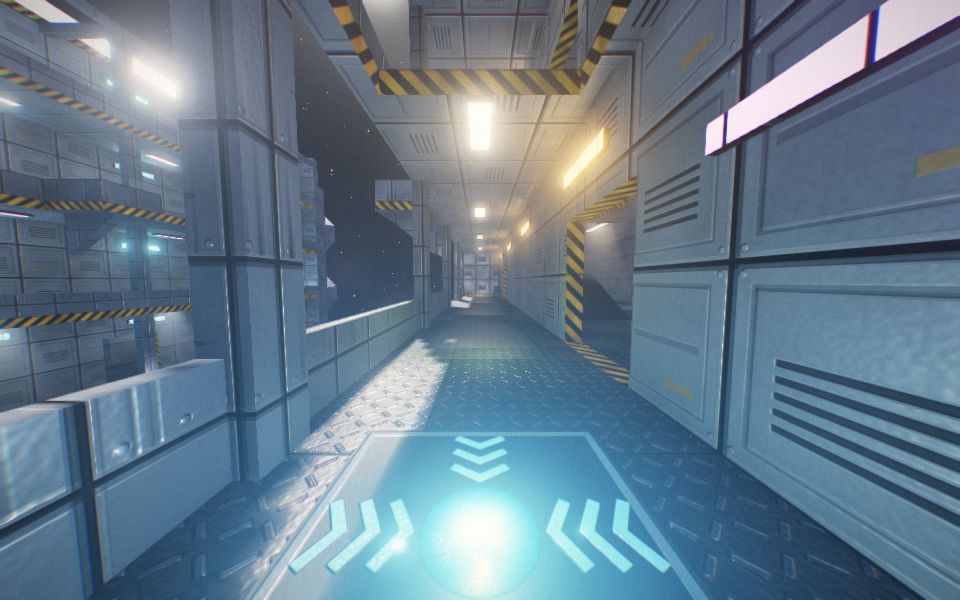
The Pangolin's bay, where every match starts, is old painted steel: panels each in their own tone, a few replaced in fresher paint, hand-set rivet rows with the odd rivet missing or swapped, paint chipped off the edges and the door frame, boot scuffs along a darker kick band, grime packed into the corners, soot round the lamps and dust streaked from the vents, a seat number stencilled under every bench and safety and hazard placards on the bulkheads. The floor is a diamond tread plate with dirt in its seams, boot marks down the walkway and mud tracked in off the ramp, and a worn yellow and black stripe on the sill. The 8 benches have padded cushions in stitched rolls with piped edges, rubbed shiny where bodies go, on tube frames polished by hands like the grab rails; vinyl headrests and harnesses. The roof is lined with foam pads, some plain, some quilted, a few let in with access panels, each its own age. The light is dim: caged dome lights throw a pool of warm light under each lamp, with the shadow of the wire guard on the walls; between the pools and in the corners it is dark. When the ramp comes down the dome lights stutter out to red combat lights, a white strip over the door comes on and a small lamp lights each rifle rack. Every bench has its own rack, 8 a carrier: while you ride, your rifle stands in it, clamped at its handguard and strapped in, and the riders rest their hands on their thighs or their harness straps. Every soldier, you included, reaches up, lifts the rifle out of its clamp and brings it in to the chest in 0.7 s as they get up, and leaves down the ramp with it in hand.
Straight into a match
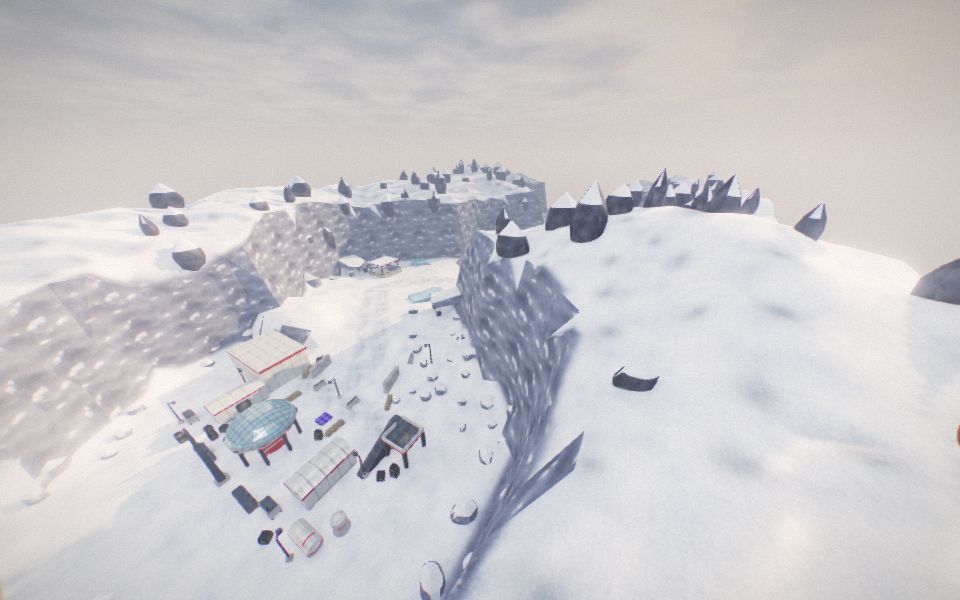
Opening the game no longer stops at a menu. You are dropped into a 16-player Breakthrough match on Rimefall: you on Red with 7 bots beside you against 8, riding in with the convoy under the opening cinematic, which hands you the controls as you step off the ramp. While it loads, a progress bar follows the real download and then names each stage (geometry, materials, soldiers and vehicles, bots, shaders), and the screen shows Rimefall from above, drawn from the level itself, with its three lanes, the sectors, both sides' starts and which way you attack, beside a short briefing and the keys. The download starts with the page, the match is made in its worker while the scene is built, and the shaders compile before the first frame: on the development PC, cold, the intro's first frame came after 36 s, where reaching it through the menu took 75.35 s (the median of 3 loads each). Esc or the Menu button opens the menu; a link with a map or a mode opens it first, as before.
A pillbox on the tunnel at The Breach
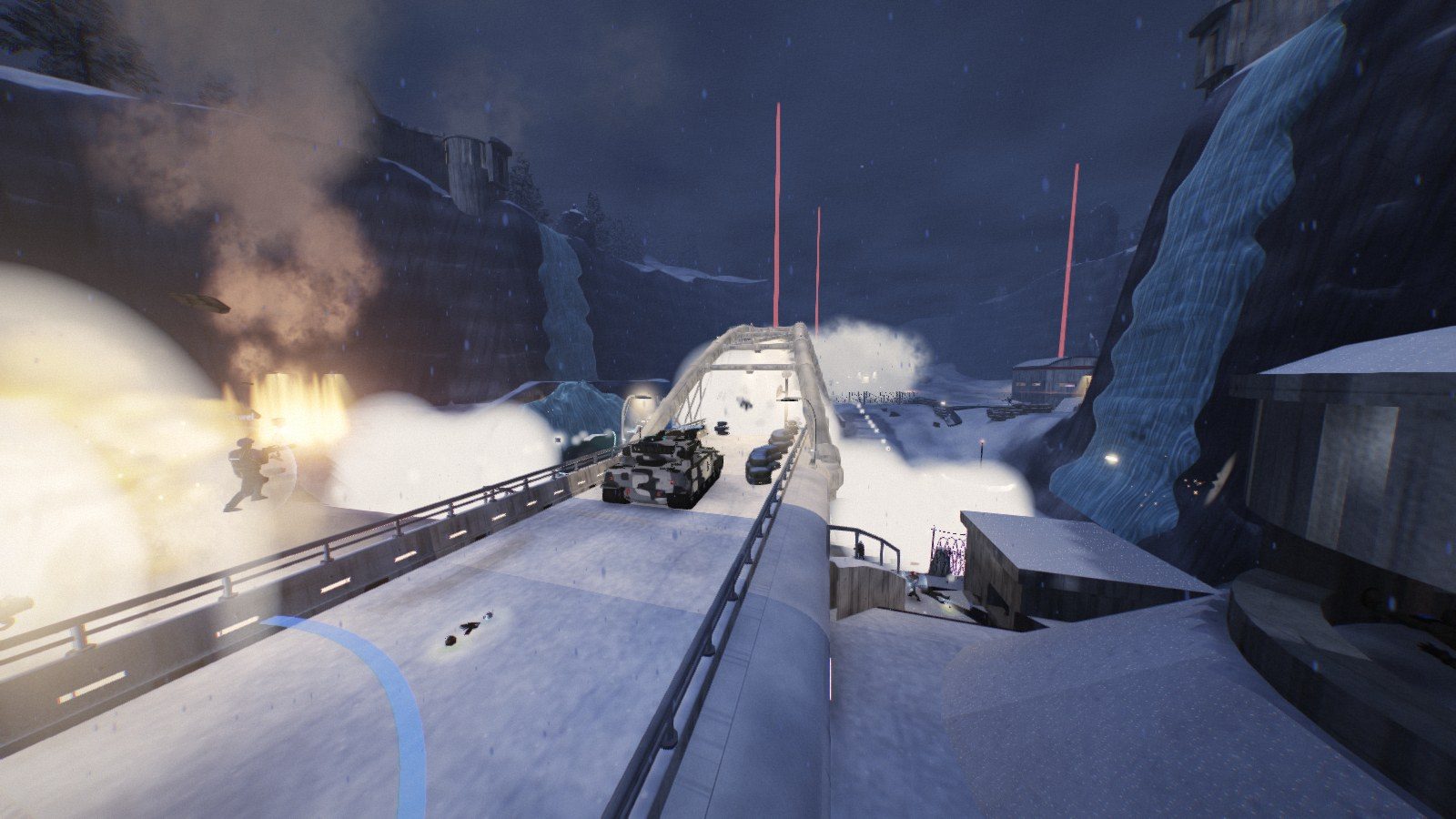
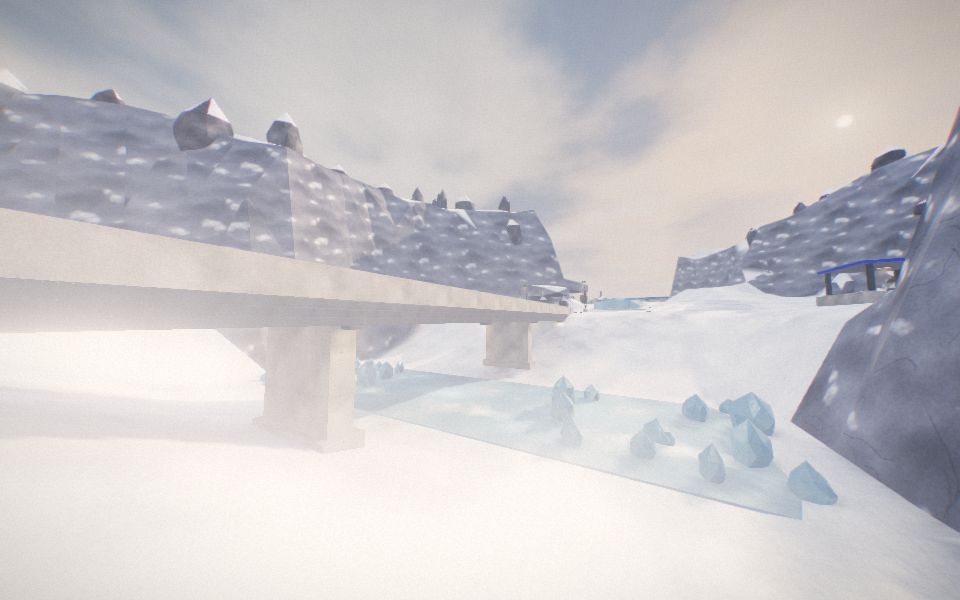
On Rimefall each side now has a pillbox at the mouth of the catwalk tunnel on the gorge's slope, a concrete box dug into the slope with its slit over the tunnel's mouth and the end of the catwalk under the bridge. Like the other hardened positions only satchels, the recoilless rifle and bangalores bring it down; tank and carrier fire does nothing to it. A short cut runs from the tunnel up to its north wall: while the pillbox stands the wall closes it, and once it is blown you can go up from the tunnel into what is left. Barbed wire closes its east and south sides and 3 concrete tank traps stand beyond the wire toward the ice; the tunnel side and its own side are left open. Its gun can never be laid on The Breach. The tunnel up to the MG nest is now two straight ramps at 1 in 2.2 with a flat landing between them, 360 units of climb with no step or notch, the bridge's deck is closed at its four corners, and the stair up to the MG nest's entrance now opens on to the canyon floor.
Ochre's ramps, made even
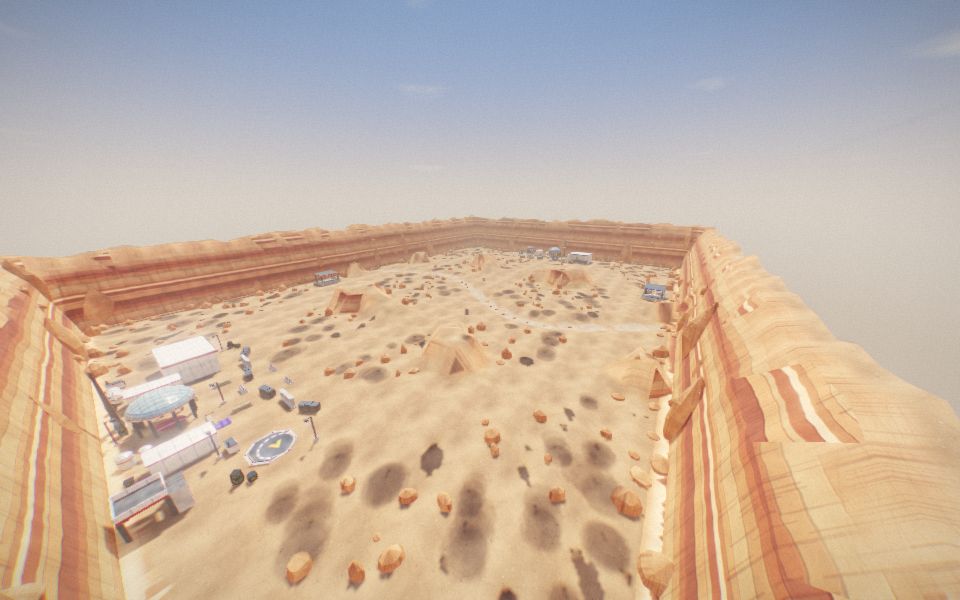
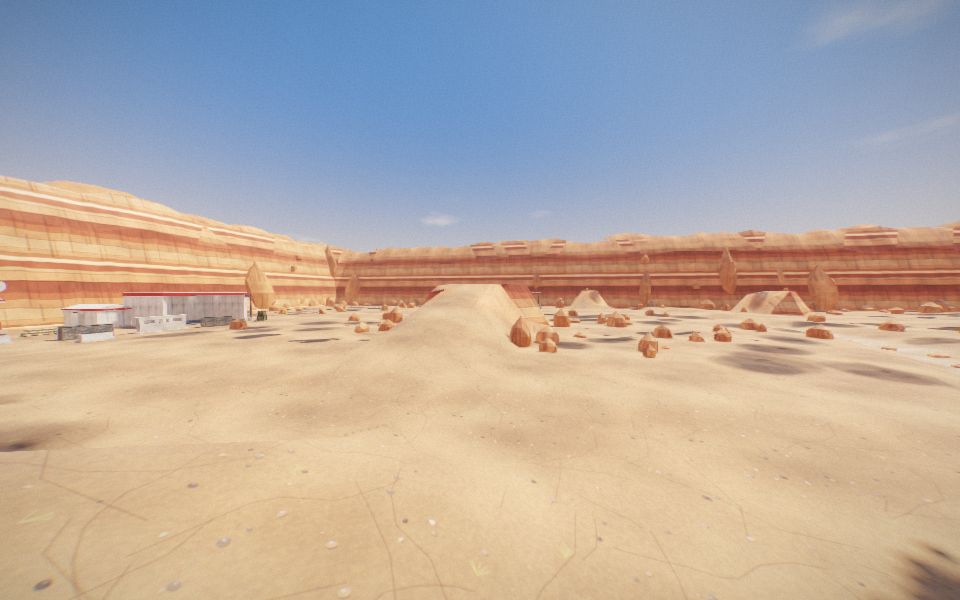
Every slope you are meant to walk or drive up on Ochre Basin is now one even ramp: 10 of them, each laid as a single plane with no step, lip or gap at either end. The 4 roads up the mesas climb a steady 1 in 4 from the flat top to the floor, an earth track whose sides round off into the mesa and the basin instead of standing up as banded walls, and a buggy drives up them. The 4 trench exits come out on to the ground flush, and the firing step stops short of the exit so you are not walking into it. The ramp up the watch tower is 1 in 2. A test measures every one on the shipped map and fails if any becomes uneven.
A commander on each side, and armour that fights
In Breakthrough each side now has a commander that looks at the match every 3 s and picks one place to break through: the lane where its soldiers and vehicles outnumber the enemy's, with the fewest guns and positions covering it and the shortest way in, with a little chance in the choice so no two matches play the same. Most of its squads and the vehicles on that lane go there. They first form up on the nearest ground they hold, for up to 22 s, while one squad makes a feint on another lane; then they go in together behind smoke, and the radio says where. Taken, they push on to the next sector; held up for 50 s, they go in again with the reserve, and then try another lane. On defence it watches where the enemy gathers and where its own soldiers are being hit, sends its reserve squad to the threatened sector, and counterattacks ground it has lost once the attackers are spent, for up to 40 s. The vehicles can now be killed: a tank takes 6 rounds from the other tank or 4 from a Ramrod, a troop carrier 3 TOW missiles, and a damaged hull mends only after 20 s out of the fight and only to 75 %. Each tank engages enemy vehicles it can see within 55 m, a bot in every four now carries a Ramrod and uses it on enemy vehicles, a vehicle that has seen nothing to shoot for 7 s drives on to find a firing position, and when a driver is shot out of the hatch the gunner takes the wheel.
Convoys that move as one
Each side's convoy now drives asa formation with a leader and slots. On the road out and through gates, bridges and gaps it goes in column, every vehicle on the leader's own track 150 units behind the one ahead, one at a time through anywhere narrower than 440 units while the next waits short of it. Where the ground opens to 780 units it spreads into a wedge, the tank at the point and the carriers 250 units out to its left and right, and closes again before the next narrow place. Every hull eases off as it nears another and never comes within 70 units of one, measured on the real hull boxes. A vehicle that cannot move backs off, then steps to the freer side, then gives up its place so the rest are not held. Where the road ends short of the objective, as under Ochre's mesas, the vehicles stand as a base of fire and the infantry go on alone. The infantry keep 90 units apart, follow their leader in a loose file, stay out of a moving vehicle's path, and take cover at a vehicle for at most 40 s before moving on with their squad.
Sappers go in with their squad
A sapper no longer walks into a defended line alone. Up to 2 of its squad go with it, a few steps behind. On Rimefall most sappers used to die to the roof gun of an enemy troop carrier parked beside the nests, so that gunner is now the first target: squadmates within 30 m who can see his head over the hatch rim fire on him, the convoy's own guns lay on him from up to 55 m, and every bot now aims at the head and shoulders of anyone riding a vehicle instead of the armour below. When a crewed vehicle has the sapper in sight, the sapper drops into cover and waits up to 24 s for smoke to stand between them, and a squadmate within 23 m throws it if the sapper has used its own. A bot carrying satchels is no longer sent to crew one of its side's guns instead of making its run. The rest of the side comes back into the fight too: the dead now respawn at the forward-most ground their side holds, unless they crew a gun at the base, and a carrier that has stood still for 8 s no longer counts as cover to wait behind.
Nobody sits out the push in a parked carrier
Bots no longer climb into a vehicle's seat when they mean to pick up a weapon lying beside it. On Rimefall two of each side's eight used to stop for a rifle by their own parked troop carrier, press use, land in its passenger seats and stay there for the rest of the match, so the middle was fought over by two or three a side. The use key boards a vehicle before it picks anything up, so a bot now leaves a weapon alone while a free seat is in reach, and a bot that does end up in a seat of a convoy's own hull gets straight back out. The front line is now measured from the soldiers in the fight, gun crews left out, and from the ground each side held at the start: on Rimefall the middle changes hands in every test match and neither side's line ends behind the ground it held.
Sappers that get there
The bots carrying satchels now bring the concrete down. A sapper goes only for a nest, pillbox, gun pit or gate it can walk up to, not one on a cliff above it. On the way it throws its smoke on the slit, or between itself and an enemy vehicle whose crew has seen it within 35 m, and drops into cover from that vehicle while the cloud grows; teammates who can see the slit put fire on it while it crosses. Once the satchel is down it runs past the blast (10 m) to ground the charge cannot see before the 5 s fuse ends. On both team maps a position now falls to them in every test match.
Bots vault on purpose
Bots now vault sandbag lines, low walls and crates on their way, where before they only did when a jump to get unstuck happened to hit one. When the route goes round something low and going over saves at least 2.4 m within 16 m, they go over. They vault by your rules: the movement code is asked first, from where the bot stands, so a bot never vaults where you could not. Bots sent to man a gun now get over its sandbag ring and onto the gun, and holding ground a squad keeps each soldier within 11 m of another.
Convoys that move as one
Each side's convoy now drives as a formation with a leader and slots. On the road out and through gates, bridges and gaps it goes in column, every vehicle on the leader's own track 150 units behind the one ahead, one at a time through anywhere narrower than 440 units while the next waits short of it. Where the ground opens to 780 units it spreads into a wedge, the tank at the point and the carriers 250 units out to its left and right, and closes again before the next narrow place. Every hull eases off as it nears another and never comes within 70 units of one, measured on the real hull boxes. A vehicle that cannot move backs off, then steps to the freer side, then gives up its place so the rest are not held. Where the road ends short of the objective, as under Ochre's mesas, the vehicles stand as a base of fire and the infantry go on alone. The infantry keep 90 units apart, follow their leader in a loose file, stay out of a moving vehicle's path, and take cover at a vehicle for at most 40 s before moving on with their squad.
Every scripted camera keeps clear of the map
The intro's camera rules now cover the game's other cameras. When you die, the camera still rises behind your body on the side away from whoever got you and turns to them, but it no longer sits inside the rock you fell against or looks up at the underside of a bridge. Watching a match (the one behind the menu, or spectating) now puts the camera over the shoulder of the player you watch instead of inside their head, and it follows them round corners and into the ice cave without passing through walls. The mortar's shell camera and the camera that frames a reported pin follow the same rules. A camera that has to stand under a roof, in a tunnel, a nest or the cave, may show that roof but not look up into it. A test samples deaths, spectated players, pins and shell cameras on every team map and fails if any frame breaks these rules.
Nest gunners open fire
A bot on a nest's machine gun now fires on an enemy in the gun's arc. It used to judge what it could see from its own head, which sits behind and below the nest's slit, so it saw nothing to shoot at; it now looks from the gun. A test puts a bot on every gun its side holds at the start of a match, walks an enemy across the arc, and fails if the gun stays silent.
Surer footing
Walking keeps you on the ground now. Over a crest, down a slope or off a step of up to 46 cm your feet stay on the floor, where before you hopped into the air at every ridge and could not turn, stop or jump until you came down. On foot you step up 51 cm (it was 46), enough for the edge of a yard slab, not enough for a sandbag wall; in the air the step stays 46 cm, so a jump climbs no higher than it did. Bots move by the same code.
Vaulting
Run at a wall and press jump, or hold jump against it, and you vault it: a top 71 to 279 cm over your feet, with room to stand on it, takes 0.35 to 0.6 s by its height. Sandbag lines, low walls, trench lips and crates no deeper than 122 cm you clear to the far side and keep a little of your speed; anything deeper you climb onto. Both hands are on the top, so you cannot shoot, throw or strike until it is over, and you can still be shot. Nest and pillbox walls, bunkers, wire, tank traps, gates, huts, towers and trees cannot be vaulted, and nothing taller than the limit. Bots vault by the same code when they jump at something.
Guns in the nests
The machine-gun nests of Rimefall were sandbags and an embrasure with nobody's gun in them. Now 6 emplaced guns stand in them, the MG nest, the eagle's nest and the gallery pillbox of each side's line, manned with E by the side that built them and taken out like any other keystone. Each sits behind its bags or slit, aimed down the ground the nest was built to cover: the eagle's nest gun traverses only 18 degrees and fires 38 degrees or more down, on to the bridge deck, and none can reach the middle site under the bridge. Bots climb up and man them, and a test now fails if a nest on any map is left without its gun.
Rimefall: a river that froze as it fell
The frozen fall over the ship is a river now: it comes in from the edge of the map and winds about 60 m across the snowfield in a channel of its own, then goes over the rim and down the gorge wall as one sheet of ice, about 24 m of it, on to the splash cone over her bow, which is closed into the rock behind it. Its twin falls into the gorge north of the bridge, so both halves still match. The curtain of ice columns that hung half way up the wall is gone. The forward post's gun moved down the slope into the round sandbagged pit in front of it, where it covers 110 degrees and dips 30 degrees on to the slope, and the advancing trench below it now stops at the pit's foot instead of offering a covered way up out of the gorge.
Tracers
Only every 4th round of a gun is a tracer now, as in a real belt or magazine, counted by the gun itself so every player sees the same rounds. The rest are not seen in flight. A tracer is a small burning round, not a line: a streak about 3.5 m long flies out from the muzzle at the round's own speed (900 m/s from a rifle, 400 m/s from a machine gun) and slows as it goes, then burns out 0.9 to 1.1 s after it was fired, wherever it is. Red fires red-orange tracers and blue fires green. They glow through smoke and haze and stand out at night, and look brighter when one comes straight at you. Now and then one kicks back up off stone (9%) or steel (14%), never off snow or earth. The Lance long rifle and the scattergun fire none.
Armour
The Bison is a main battle tank on tracks with a turret and 1,800 hull points. The Pangolin is a six-wheeled troop carrier with 1,400 hull points, a roof cannon and a rear ramp. Hatches open and crews climb in and out, and every vehicle model is checked so no part floats off its hull.
Insertion: everyone starts in the carriers
A Breakthrough match (and Front Line or capture the flag, when asked) starts with every player, people and bots, seated in the troop bay of an Pangolin: 8 benches a carrier, always 3 carriers a side, the riders spread over them. Each side's convoy is 8 vehicles, all crewed by NPCs: a Bison tank in the lead, the carriers, 2 buggies for the flanks, a supply carrier that tops up the ammunition, grenades and satchels of anyone standing by it, and an outrider. It stands for 1.5 s, then drives up the lane to 450 units short of the first contested sector. The tank stops there and covers the drop. Each carrier throws 6 smoke pots, drops its ramp and walks its riders out one every 280 ms. Then the carriers and the tank crawl on as one formation with the infantry at 60 units a second, slower than a crouch-walk (96; a soldier runs 240). They wait for anyone who falls behind or goes down and stop at a cover point every 380 units. Bots take a place at the left, right or rear of a carrier, away from the threat, keep pace and shoot past it. The gunners shoot first at whoever is firing on the infantry, then at gun crews, keep a manned embrasure's crew down with short bursts, and fire short suppressing bursts at the objective when nothing is in sight. They never shell empty concrete they cannot break. They leave the other side's armour alone unless it fires on them from within 760 units. A carrier smokes again when it is hit hard, and backs into cover when it is badly hurt. None of the convoy respawns, and nobody respawns into it. The match opens on a short intro: 7.4 s on the two convoys rolling out, tank first, a crane beside your own carrier on the road, the smoke and the ramp, then 1.3 s into your own eyes as you step off. Skip it with Space, or turn intros off in the settings.
The intro camera keeps clear of the map
The match intro's camera now checks the map before it films. Each shot is still written as a place beside the convoy, but every frame the camera is tested against the map's own collision: it may not sit in rock or brush a vehicle, it needs open sky straight above it, most of what it films must be in clear sight, and few of its view rays may land on the underside of anything or on a bank close in front of the lens. When the written place fails, it tries up to 140 places round the subject, turning, rising and moving in, and takes the nearest to the written shot that passes; when none does, it films from high above. It keeps a place until the written one has been clear for 450 ms, and slides between places over 350 ms, so it does not flicker. A test plays the whole intro on every team map for both sides and fails if any frame breaks these rules.
Armour in detail
The Bison and the Pangolin now read as armour: the tank's turret carries wedge armour on its cheeks and bolted modules down its sides, with a commander's panoramic sight, a canvas mantlet cover and baskets of kit round the back. Its glacis takes add-on plates, its skirts reactive blocks, and its sponsons a hard edge strip. The carrier gets bolted panels along its flanks under a shoulder strip, a remote weapon station on the roof, periscopes round every hatch and tyre-inflation hubs. Both carry tools, tow gear, jerry cans and guarded lights: 177 small parts on the tank and 141 on the carrier, which fold away at a distance like the soldiers' kit. Every one of them is attached to its hull.
Inside the troop carrier
The Pangolin's bay is modelled inside: 431 parts of lined walls and roof with ribs and quilted pads, a tread-plate floor, 8 fold-down benches with harnesses, grab rails, 6 dome and combat lights in your side's colour, vision blocks, a stowage net, intercoms and a fire extinguisher, and a door in the ramp. Seated on a bench, you see the bay round you, closed on every side until the ramp drops. It is drawn only when you are inside or behind the open ramp.
Reinforcements that fight
Call the Pangolin in and it drives toward the objective, halts, lays smoke, drops its ramp and puts out 10 marines who do not respawn. Then it stays to support the push with its cannon. The marines fight on the bots' own code and count in the match, but not on the scoreboard as players.
Reinforcement gates
Rimefall has 2 armoured hatch gates, one by each base, that open to let a tank or the troop carrier drive out as reinforcements. A gate opening is part of the match record, so everyone in an online match sees it.
Weapons in the hand
Every gun is held in two hands, with 23 kinds of animation across 20 weapon and pickup models: raising and lowering, reloading, inspecting, sprinting, charging and venting heat, pumping and throwing. Soldiers' small parts fold away at a distance so a full match stays smooth.
Ropes up the cliffs
Rimefall has 4 rope ascenders, two up each wall over the gorge. Press E at the foot and a winch draws you up at 110 units a second: about 13 s on the open face for a climb of 1,288 units, slow enough for a machine gun across the gorge to shoot you off, and Space lets go. It lets you down at 160. At the top a covered bunker and a gallery along the rim lead to an eagle's nest, a casemate on the cliff's edge whose narrow stepped embrasure under a concrete hood looks down on the bridge and across to the other nest, never on a spawn. Bots ride them too.
The underground train
On Rimefall a line runs under the map between 2 stations, one behind each vehicle bay, which goes four times as deep into the rock now. Call the train at your station's call point, or the director sends it with its train.run lever: it comes in from outside the map, stands 9 s with its doors open, carries your squad under the map and lets it off at the enemy's station, behind their base. 57 s from the call to gone, then 30 s before it runs again. The train is part of the match record, so everyone online sees it.
Real track under the train
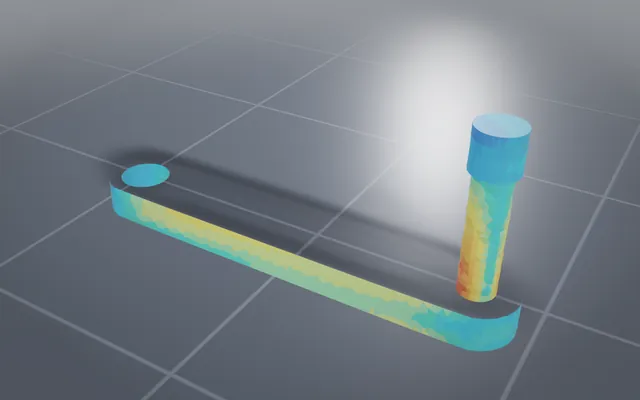
The line's track is drawn as track now, the whole way from one end to the other: two steel rails with a polished running band on their heads, concrete sleepers every 600 mm with pads and clips under the rails, and ballast stones heaped between and at the shoulders. The sleepers are spaced along the track's length, so they keep the same pitch through every curve, and each one is a little different from the next. Seen low down, the ballast sinks between them and they stand up out of it. The rails are 1,435 mm apart, standard gauge, the same as the train's wheels. It takes the station lamps, the night and the fog like the rest of the map, and the whole line is one draw for the graphics card.
Try the recoil
5 recoil models to choose in the options: “Classic”, “Low and steady”, “Pattern”, “Scatter” and “Heavy and slow”. Classic is the default. Bots fight with the model you pick, so a harder one makes them miss more in the same proportion. A mounted gun has one sight, and fired from the hip it holds steadier.
Breakthrough
A new mode on the team maps. Each side starts behind a strong line of 6 kinds of keystone: MG nests, pillboxes, mortar pits, gates, wire and radios. The hardened ones (MG nests, pillboxes, mortar pits and gates) fall only to the infantry's demolition: small arms, vehicle cannon, missiles, rockets, grenades and mortar rounds take nothing off them, so neither a sniper nor a tank can move the line, though their fire still keeps the crew's heads down. A satchel planted within 150 units of the slit takes one down and goes off 5 s later, one bot in 3 of each side spawns as a sapper with 2 of them, the two-man Ramrod recoilless reloads 2.5 times faster with a loader beside the gunner, and mortar rounds now fly 4.2 to 5.6 s. A sector flips once its keystones are down and a side holds it for 8 s, and spawns follow the front. Lane creeps come every 30 s, 3 a lane, at most 6 a lane and 18 in all. Destroying a keystone under fire, wounded or pinned, near enemy guns and nearly alone, earns a citation: the Breach Ribbon, the Frostline Clasp and the Thornwall Star. The scoreboard counts the metres each player moved the line.
Smoke and fire
Five kinds of smoke now stand over a match. A screening smoke rises into a column about 38 m tall and lasts 30 to 60 s, drifting and leaning with the wind. A match opens with a barrage of them landing between the lines, 3 on the convoys' road and 2 on every other lane, and a mortar can fire them too: press R on the tube to switch between HE and smoke. Blow up an MG nest, a pillbox, a mortar pit, a radio or a store of fuel and drums, and it burns as an oil fire for 45 to 90 s, flames at the base and a dark column about 80 m high that you can see across the map. A destroyed vehicle burns longer, 80 to 120 s. A vehicle's smoke dischargers throw 6 pots that stand as a wall in an arc ahead of it for 20 to 30 s, and a coloured signal smoke marks a spot for 12 to 18 s. Bots, gunners and emplaced guns cannot see or aim through dense smoke, and name tags hide behind it. Each frame draws at most 12 columns and 320 billboards, the nearest first.
No more seeing out of the map
Every place a player's eye can be is now checked for what it sees: standing and crouched at every point the bots can reach, at the rope tops, in the embrasures and the vehicles' seats, and in the flyer at its ceiling. Rays fan out all round and from straight down to high overhead, and none may meet the empty space under the horizon. The holes that let it through are closed: the ice cave's lining now meets its floor and the rock is drawn where the lining does not cover it, the mountain pass's tunnel bends to a closed end inside the map, the cave's ice, the frozen fall, the base buildings, the trench boards and the ground are drawn from both sides, the undersides of lintels and slit heads are drawn where they are open, the thin shavings left where solids meet are kept as drawn stone instead of dropped, and on Ochre Basin a ridge of tilted beds rises behind the canyon's rim so a flyer sees rock under the horizon and sky over it.
Rimefall, worked over
The cliff-top nests are now casemates: the old chute of concrete is gone, and each looks out through a narrow embrasure whose reveals step in toward the gunner, under a hood that keeps the sky off. The tunnel up from the bridgehead opens through a concrete headwall with a round arch and wing walls, a steel stair with handrails and a landing climbs the steep gallery to the machine-gun nest, and the dig's ice benches are closed at the back, so nobody sees through the wreck from beside the frozen fall.
Craters
Shells now dig the ground. A mortar round leaves a crater 2 m across and 0.5 m deep in the snow or the sand, a tank shell one 2.8 m across and 0.55 m deep, a satchel one 4 m across and 0.7 m deep, each with a raised rim and the earth turned over in it. Grenades only scorch, and concrete, walls and vehicles never cave in. Rounds that land together merge into one hollow, never deeper than 1 m, and a match keeps up to 64. What you see is what you stand on: the ground's collision is cut down to the same 25 cm grid the crater is drawn on, so you can crouch in one for cover, and a carrier or a tank drives through them. Every player, including someone who joins late, gets the same craters.
Crewed mortar
Step up to a mortar pit and dial the range with the mouse wheel, 25 m to 250 m, 3 m a notch or 25 m with shift held, shown on screen to the metre. The range on screen is where the round is aimed. Each pit throws a little off, about 3 m, so read where the first round lands and walk the next ones in. From 100 m out nearly every round falls inside a pattern 10 m wide; closer in the pattern widens fast, to about 40 m at the shortest range.
An AI director
A director can watch the score and pull 19 levers: send in 5 kinds of NPC (trooper, marine, veteran, heavy and creep), order squads and vehicles about, drop supplies, call a wave, change the weather and deploy the troop carrier or open a gate. Its built-in rules keep at most 6 of its NPCs alive at once. An AI on the same computer can drive it through a local connection, which stays off unless the host turns it on.
Radio voices
The bots' radio calls are spoken by 6 recorded voices, men and women with US and UK accents, rendered offline by the open speech model Kokoro-82M (Apache licence): 956 takes a voice, every place name said inside the line itself across 27 places, 11.1 MB in all. They come over a radio, band-limited and a little driven, with a click at key-up and the squelch at key-down, one call at a time, and each soldier keeps the same voice all match. The options set their volume.
Field Report
Anyone playing can file a report from inside the match: press F8, and your input pauses and your camera holds still while the match goes on around you. Click where the problem is to drop a pin on it, or in the air, then pick bug, feature request, balance and art, give it a title of up to 120 characters and say what happened. The report carries the map, mode and match time, your camera and the pin, what is under the pin, your team, weapon and vehicle, the frame rate, the build and a small screenshot, never your callsign, chat or address. Played on the developer's own machine it lands as a pin in Pinpoint, opened at your camera; on the website it goes with the anonymous statistics, 5 a session at most, and only while they are on.
A smoother match
Your own match now runs in a background thread of the browser, so the page only draws: the bots, the convoys and their crews, the smoke and the craters are stepped every 8 ms on their own core, and everyone else is drawn 24 ms behind it while your own soldier still answers your keys at once. A shot is sent the moment you press. The bot match behind the menu runs there too, and Join match steps you into it. The convoy crews ride heads-out of their hatches and can be shot, and every match carries up to 64 soldiers on the wire, so a room shows them too. A performance overlay (the perf switch in the page's address) shows where each frame's time goes.
Play statistics
To balance the game, a match can record 16 kinds of anonymous event, such as spawns, deaths, hits, shots, captures and frame rate, under a random ID. From those come deaths per match, time to kill, and hit rate by weapon and by recoil model. It never records your callsign, chat, room codes or IP address, and one switch in the options turns it off and erases anything waiting to be sent.